Comprachicos parchment
The Man Who LaughsThe Comprachicos parchment is a shipwrecked crew’s declaration written on the reverse of a royal order that had served as a receipt when they bought a child. Carried to shore inside a sealed bottle, the document turns a concealed transaction into evidence: alongside the crew’s testimony and the official examination of the bottle, it helps establish Gwynplaine’s identity and the royal authorization behind his fate.
The sheet and its two sides
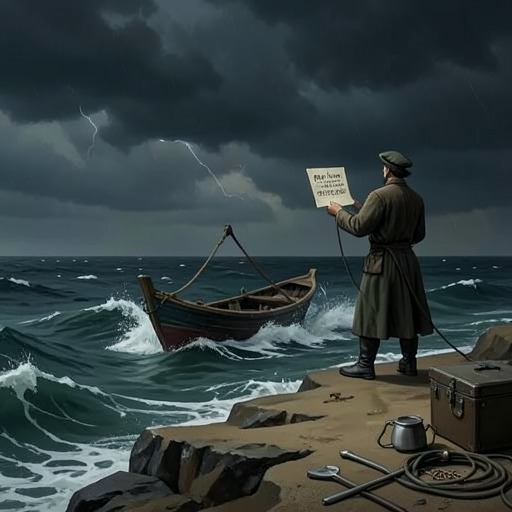
The surviving account presents the parchment as a single sheet bearing two linked records. On one side was a declaration made at sea aboard the Matutina, a Biscay hooker from the Gulf of Pasages. The skipper had been swept away, leaving two men of the crew, who signed the statement. At the foot of the sheet, the declaration identified the vessel and its location.
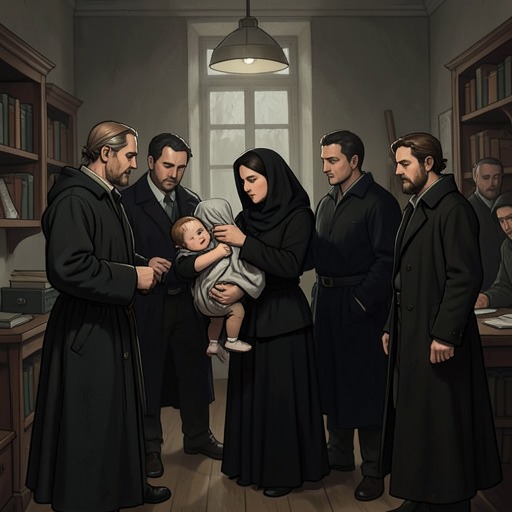
The declaration also directed its reader to turn the leaf: it had been written on the back of the royal order given as a receipt when the crew bought the child. The sheriff described the sheet as a legal document bearing the mark of James II. On its other side, the aged, mouldy surface appeared blank at first; held up to the light, it disclosed the inscription Jussu regis and the signature Jeffreys. The juxtaposition makes the paper itself a record of both the transaction and its authorization.
From the sea to official evidence
The parchment reached the authorities inside a gourd flask sealed with tar. The account describes the bottle as battered by its time in the water, with shells and seaweed adhering to its wicker covering. The sheriff identified it as the container in which the men facing death had placed their declaration, and as a message that the sea had delivered to justice.
Its recovery depended on a specific maritime office. A ship could send information ashore in a sealed bottle; a bottle cast onto land fell under the jurisdiction of the jetsam officer. The Admiralty treated such messages as valuable records of a ship, its crew, the place and manner of its loss, and the conditions at sea. The office-holder received sealed vessels and had authority to open them, while the described procedure required two sworn Admiralty jurors to witness an opening and join the official report. In this case, Barkilphedro said that he opened the flask with two sworn jurors present, reported its contents to the Queen, and completed the required formalities before the confrontation.
The parchment was only one element of the proof. The sheriff also examined the wickerwork of the gourd, where the name Hardquanonne could be traced in red reed. The declaration, the royal order, the inscription and signature, and the name recovered from the bottle thus formed a chain of evidence rather than a solitary revelation on a page.
What the document establishes
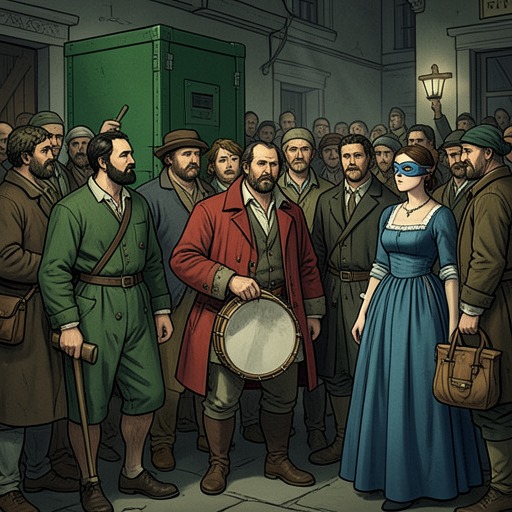
Read aloud during the proceedings, the sheet linked the child’s purchase to an order attributed to James II. The bottle’s contents and the subsequent confrontation identified Gwynplaine as the person whose childhood had been altered and whose birthright had been concealed. Barkilphedro then announced that Gwynplaine was a peer, a legislator and judge, and entitled to an annual income of £40,000, as well as being destined to marry a duchess. The parchment did not accomplish this change by itself: its force came from its combination with the declaration, the bottle’s other identifying evidence, and the official process that authenticated and presented them.
The document’s evidentiary role was later recounted among the grounds for recognizing Lord Fermain Clancharlie. The account joins the waif-flask and the Comprachicos parchment to the royal command signed by Jeffreys, the confrontation at Southwark, and the Lord Chancellor’s and Queen’s acknowledgment of the facts. In that sequence, a private record recovered from the sea becomes part of the public basis for Gwynplaine’s restored status.
The parchment as a mark of royal power
The order’s inscription does more than connect the purchase to a monarch: it makes royal authority legible within the record of the child’s treatment. When Gwynplaine later addresses the House of Lords, he describes his permanent smile as a mark placed by a king and reads it as an image of the people’s suffering under their rulers. The narrative likewise interprets the scar on his face as bearing the meaning of Jussu regis. The parchment and the face therefore carry related signs: one records a royal command in writing, while the other is presented as its lasting consequence.
The paper’s passage from a shipboard declaration to an Admiralty examination and a parliamentary account gives the object a structural significance beyond its role as a clue. Its authority depends on physical survival, a regulated chain of custody, sworn witnesses, and official recognition. Yet the record those institutions validate also implicates royal power in the history it brings to light. The parchment helps restore Gwynplaine’s legal identity while preserving evidence of the command that helped dispossess him.